


 Breathing
Caring for others takes a lot from you: long hours, little rest, and a steady flow of other people's pain. Stress and burnout are common in healthcare, and most of us push on without noticing how tightly we are holding ourselves. Breathing is one of the simplest ways to loosen that hold. It costs nothing, it needs no equipment, and you can do it between one patient and the next.


Why breath matters
You already do it. You can also steer it.
Breathing runs on its own, yet it is one of the few body functions you can take over at will. Slow, even breaths signal to your nervous system that you are safe enough to settle. Research on slow breathing suggests it can lower stress and tension, ease anxiety, and help with sleep and focus. It is not a cure, and it does not replace rest, support or treatment. It is a tool you can reach for in the moment.
The practice has deep roots. Pranayama, the yogic art of controlled breathing, is thousands of years old. More recently, James Nestor's book Breath: The New Science of a Lost Art brought the topic to a wide audience by tracing how breathing shapes our health.
Your body tells you first.
A tight chest, a clenched jaw, shallow breaths, butterflies in the stomach: these are early signals of strain. Noticing them is the first step. Before you start a breathing exercise, name what you feel and set a simple intention, such as "I will take two calm minutes for myself."
Three ways to start
You don't need a mat, a quiet room, or an hour. Begin with one of these and keep it small.
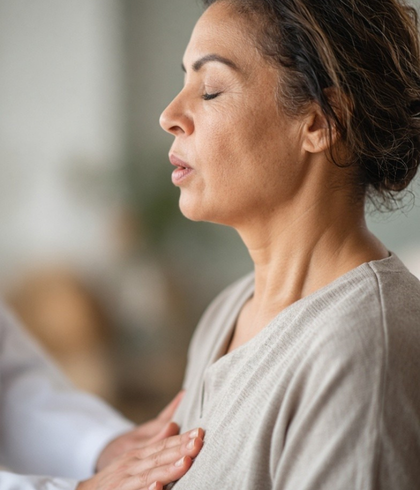
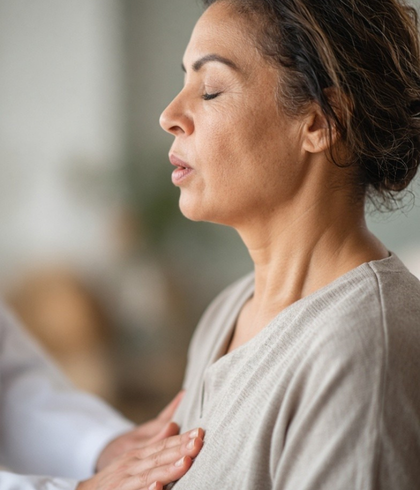
The two-minute reset. Sit comfortably and place a hand on your belly. Breathe in through your nose for a count of four, then out slowly for a count of six. Let your belly rise and fall. Repeat for two minutes. Do it at your desk, in the car park or before a handover.
The doorway breath. Choose a moment you already repeat every shift, like washing your hands or walking into a patient's room. Take one slow breath each time. One breath is enough to mark the change from the last task to the next.
The daily anchor. Choose a regular time, such as before you leave for work or after you get home, and practise for five minutes. A fixed time turns an intention into a habit. If you can, step outside and take in some fresh air.
Boundaries make these practices easier to keep. Take your breaks, say no to tasks outside your role where you can, and protect time away from work. A few calm breaths work better when the rest of your day leaves room for them.
Going deeper: what slow breathing does
The longer exhale is the lever.
When you breathe in, your heart rate rises a little. When you breathe out, it slows, helped by the vagus nerve, which carries calming signals from the brain to the heart. A longer exhale leans on that slowing effect, which is why "in for four, out for six" feels settling.
Six breaths a minute.
Breathing at about six breaths a minute, often called resonance or coherent breathing, has been studied for its effect on heart rate variability, a measure of how flexibly the body responds to stress. Small trials and reviews report modest drops in stress and anxiety. Many studies are small, and their results vary, so treat it as a useful habit, not a proven treatment.
Try it for five minutes.
Breathe in through your nose for a count of five, then out gently for a count of five. That is one breath every ten seconds, or six a minute. Keep the breath soft and quiet, and let your shoulders drop.
Go gently.
Never force a breath or strain to hold it. Stop if you feel dizzy or light-headed, and return to normal breathing. If you have asthma, a heart condition or are pregnant, check with your doctor before trying breath-holding or fast breathing techniques. Intense methods, such as holotropic breathwork, are best done only with a trained facilitator.
When it is more than stress
In a national survey of about 8,500 Australian healthcare workers during the pandemic, around 1 in 10 reported thoughts of suicide or self-harm, and 13% of doctors did (Bismark et al., 2022). This kind of strain is common, and there is nothing to be ashamed of.
Breathing can help you steady yourself, but it cannot carry everything. If low mood, hopelessness or exhaustion has lasted for weeks, or you have had thoughts of harming yourself, please talk to someone today. A GP, a psychologist or a trusted colleague can help, and so can these free services in Australia:
Lifeline: 13 11 14, available 24 hours.
Beyond Blue: 1300 22 4636, available 24 hours.
Nurse & Midwife Support: 1800 667 877, available 24 hours.
In an emergency: call 000.
Healthcare professionals often hesitate to ask for help. You would not hesitate to support a patient or a colleague in the same place. You deserve the same care.
Quote
Small breaths, steady shifts


One slow breath will not fix a hard shift. It gives you one steady moment, and steady moments add up.
Patricia Maris, Founder, e7D-Wellness
Where does your wellbeing stand?
Breathing is one of the eight pillars of wellbeing in MarisMetrics, alongside Willpower, Hydration, Thoughts, Nutrition, Movement, Rest, and sexual vitality. If you are not sure where strain is building up, start with our free compassion fatigue assessment. It takes a few minutes, it is private, and it shows you where to begin.
Key Takeaways
Breathing is a tool you can use mid-shift, with no equipment and no cost.
Slow, even breaths, such as in for four and out for six, help your body settle.
Start small: two minutes at your desk, one breath at each doorway, or five minutes at a regular time each day.
Breath-work supports your wellbeing but does not replace care.
If you are struggling, talk to a GP or call Lifeline on 13 11 14.
View Recommended Resources
Bismark M, Scurrah K, Pascoe A, Willis K, Jain R, Smallwood N. Thoughts of suicide or self-harm among Australian healthcare workers during the COVID-19 pandemic. Australian & New Zealand Journal of Psychiatry, 2022; 56(12): 1555–1565.



 Willpower