




 Sexual Vitality
Thank you.
Thank you for the care you give, often at the cost of your sleep, your meals, and your evenings. You spend your days paying close attention to other people's bodies and needs.
And a quiet question.
When did you last talk, really talk, with someone about what you want in your intimate life?
What the research shows
A meta-analysis of 48 studies found that couples who talk openly about sex report better sexual function, including desire, arousal and orgasm. The link was strongest for overall sexual function and in married couples. The effects were modest, and the studies show a link, not proof that talking causes better sex [1].
Shift work appears to matter too. In a study of 163 nurses, those working night shifts had lower sexual function scores and higher depression scores than nurses who worked days only [2].
Sleep may be the key. Among 754 men attending an andrology clinic, shift work on its own was not linked to poorer erectile function. But men with shift work sleep disorder scored 2.8 points lower on erectile function than men without it [3].
And fantasies are far more ordinary than most people fear. In a survey of 1,516 adults, 30 of 55 sexual fantasies were common for men, women or both, and very few were rare. Women in particular separated fantasy from what they actually wanted to do [4].
Treat the findings as a guide, not a rule. Most of these studies are small, done in one country or one clinic, and measure links rather than causes.
Why it is hard to talk about
Many of us were never taught the words. Stigma, insecurity, fear of judgement or rejection, and not knowing what we want ourselves all keep the bedroom door closed.
Healthcare work adds its own layers. Rosters that don't line up with your partner's. Exhaustion after a run of nights. And after a day of caring for others, you may have little energy left to ask for care yourself. None of this means something is wrong with you. It means your intimate life deserves the same attention you give everything else.
Know yourself first
Before you talk with anyone else, spend a little time with these questions. Your answers are private. Journal them if it helps.


What turns me on? Think about all your senses: what you see, touch, smell and hear. Think also about emotional connection, feeling confident in your own body, and novelty. Everyone's list is different.
What do I fantasise about? Fantasies are a normal part of sexuality, and they vary widely. Having one doesn't mean you want to act on it [4]. Ask yourself: is this for my imagination, or something I'd like to explore?
What am I curious about? Is there anything new you'd like to try, or understand better?
Where are my firm boundaries? Think about past experiences. What felt good? What made you uncomfortable?
How important is sex in my life right now? Separate what you really want from what you think you're supposed to want.
How to start the conversation
These are general suggestions, not therapy or a treatment plan.
Pick the right moment, not in the heat of the moment, and not straight after a night shift. Choose a time when you're both rested and can focus.
Use "I" statements. "I'd love more time together on my days off" lands better than "You never…"
Listen as well as you speak. Show empathy and curiosity, even when your partner's wants differ from yours.
Start small. One honest sentence is a beginning. You don't need to cover everything at once.
Make consent ongoing. Either of you can say no, or change your mind, at any point.
Expand slowly. If you want to explore something new, take small steps and check in afterwards.
Plan around the roster. If your shifts rarely line up, planned time together isn't unromantic. It's how many shift-working couples protect intimacy.
Protect your sleep. Sleep loss affects desire and sexual function, so rest is part of this too.
Good to know: desire isn't fixed. It shifts with sleep, stress, health, medicines and life stage. A change in desire is information, not a failure.
What the studies cannot tell us
Cause and effect. Talking about sex is linked to better sexual function, but better sex may also make talking easier [1].
Everyone's experience. The shift work studies looked at specific groups: female nurses in Turkey [2] and men at one US clinic [3]. Results may differ for you.
What is right for you. Research describes averages. Your needs, values and relationship are your own.
When to get help
See your GP if you notice an ongoing change in desire, pain during sex, or difficulty with arousal or erections.
These can be linked to sleep, medicines, hormones or other health conditions, and many are treatable. A sexual health physician, psychologist or sex therapist can also help you and your partner talk more openly.
If anything in your relationship doesn't feel safe or consensual, call 1800RESPECT on 1800 737 732. If you need to talk to someone now, call Lifeline on 13 11 14. In an emergency, call 000.
Asking for help with your intimate life is as reasonable as asking for help with your sleep.
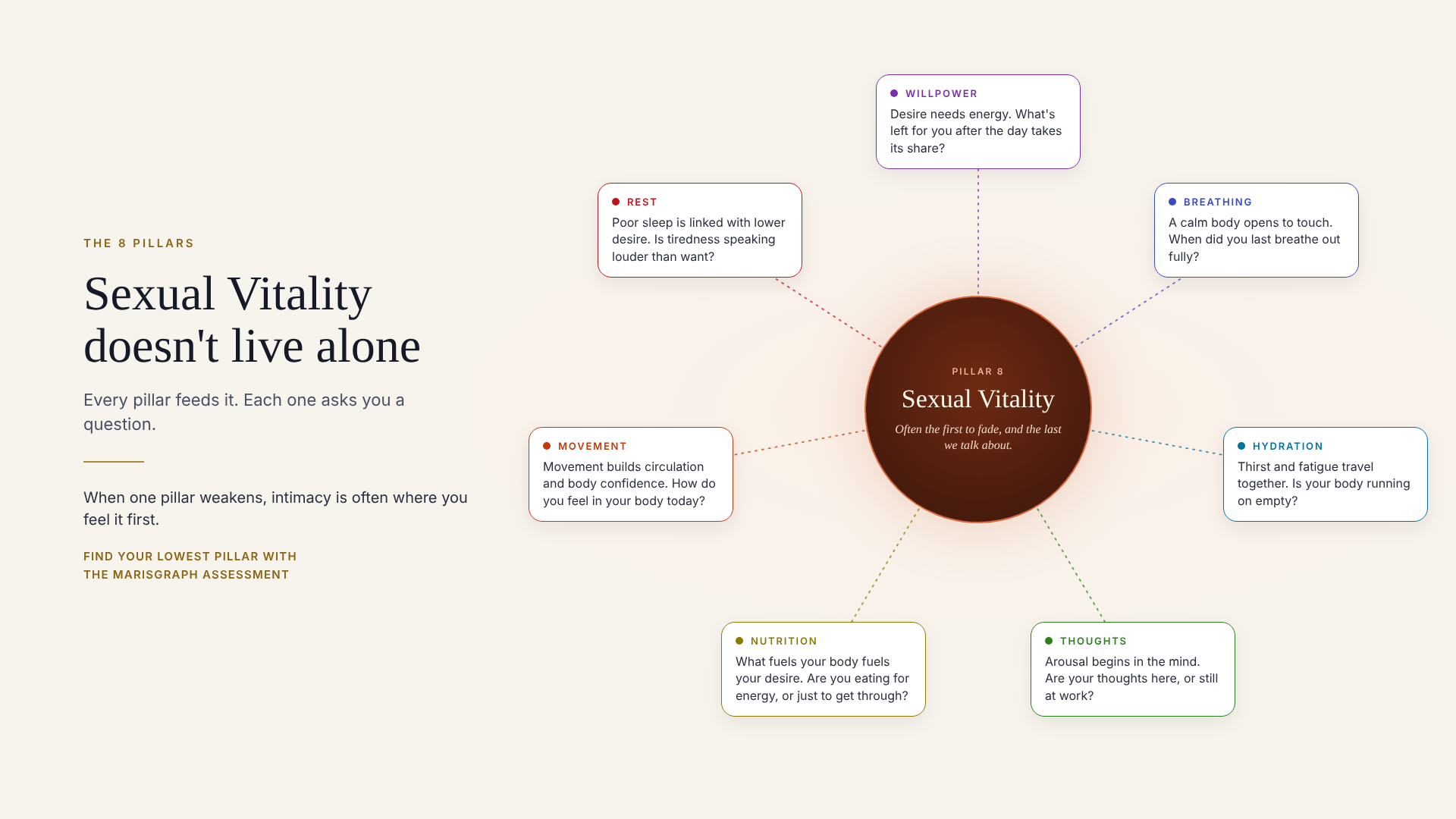
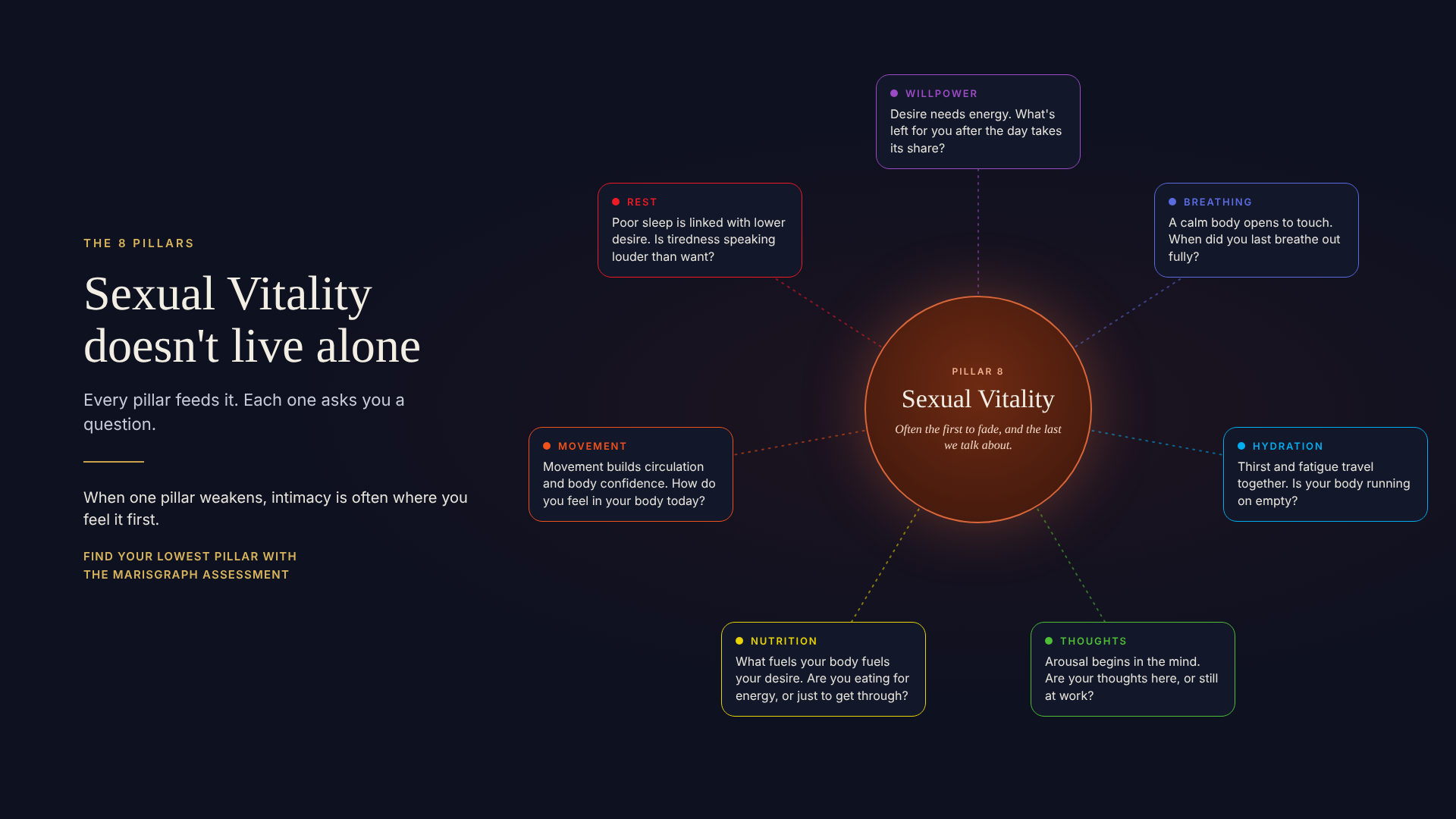
Intimacy is part of a full life.
Sexual vitality isn't separate from the rest of your wellbeing. It's tied to your sleep, stress, sense of self, and closest relationships. Paying attention to it is part of looking after yourself, not a luxury.


| "The quality of our relationships determines the quality of our lives."
— Esther Perel, psychotherapist.
How connected are you, really?
The MarisGraph Assessment looks at all 8 pillars of your vitality, including Sexual Vitality. It's not a diagnosis. It's a clear picture of where to start.
Your score for Sexual Vitality and the other 7 pillars
A starting point: your lowest pillar first
About 20 minutes, free to take
Key Takeaways
Talking helps. Couples who communicate about sex tend to report better sexual function [1].
Shift work and sleep matter. Night shifts and poor sleep are linked to lower sexual function [2][3].
Fantasies are common. Most are shared by many people, and having one doesn't mean you must act on it [4].
Know yourself first. Reflect on what you want, what you're curious about and where your limits are.
Help is available. Your GP, a sexual health physician or a therapist can help when something isn't right.
View Recommended Resources
Mallory AB, Stanton AM, Handy AB. Couples' sexual communication and dimensions of sexual function: a meta-analysis. The Journal of Sex Research. 2019;56(7). source
Bilge Ç, Kaydirak MM, Gür Avci D, Hotun Sahin N. Effect of shift work on depression prevalence and sexual life of female nurses: a correlational study in Turkey. International Journal of Sexual Health. 2020. doi:10.1080/19317611.2020.1819502 source
Rodriguez KM, et al. Shift work sleep disorder and night shift work significantly impair erectile function. The Journal of Sexual Medicine. 2020;17(9). doi:10.1016/j.jsxm.2020.06.009 source
Joyal CC, Cossette A, Lapierre V. What exactly is an unusual sexual fantasy? The Journal of Sexual Medicine. 2015;12(2):328–340. doi:10.1111/jsm.12734 source
Recommended Reading
Two books by Patricia Maris for readers who want to go further:
Sex for The Third Age looks at intimacy and sexual relationships in later life. Written for couples, divorced and single people over 45, it covers the physical and emotional changes that come with age and practical ways to keep a fulfilling sex life. It's also useful for health professionals who work with this age group. [link]
IQ Eroticism (from the Naught to Ninety Nine series) explores how knowledge, understanding and emotional intelligence can enrich your erotic life and relationships at any age, and how mental and physical health shape your sensual life. Available on Everand and Decitre. [link]
Patricia has spent 28 years helping people improve their health, fitness and quality of life. She studied psychology at Curtin University and is the author of Sex for The Third Age and IQ Eroticism. Through e7D-Wellness and the MarisGraph Assessment, she now focuses on the wellbeing of healthcare professionals, including the parts of life that are hardest to talk about.
“Your intimate life shouldn’t be on hold just because you’re exhausted, busy or working nights. You deserve closeness now, not someday.”



 Rest




 Nutrition







 Thoughts
