




 Breathing
Thank you.
For every breath you've counted at a bedside, every chest you've watched rise and fall, every time you've told someone, "Just breathe, slowly now."
And a quiet question.
When did you last notice your own breathing? And what is it trying to tell you?
You probably know the official reasons you're tired: the roster, the workload, the short staffing. But underneath, something more personal often holds your health back. A boundary you keep crossing. A worry you don't say out loud. A need you keep putting last.
Your breath often knows before you do. This article will show you how to listen.


What the research shows
Breathwork lowers stress. A meta-analysis of 12 randomised controlled trials with 785 adults found that people who practised breathwork reported lower stress than those in control groups. The effect was small to medium, and most studies had a moderate risk of bias [1].
Five minutes a day can lift your mood. In a one-month randomised trial, daily five-minute breathwork improved mood and lowered physiological arousal more than spending the same time on mindfulness meditation. The most effective technique was cyclic sighing, which focuses on a long, slow breath out [2].
Slowing down changes how you feel. A systematic review of 15 studies found that breathing slower than 10 breaths a minute was linked to greater heart rate variability and to people feeling more comfortable, relaxed, alert, and calm [3].
Treat these findings as a guide, not a rule. The studies are mostly small and in healthy volunteers, not specifically in healthcare workers.
Your breath is a messenger
You breathe more than 20,000 times a day without thinking about it. That's exactly why your breath is such an honest witness. It responds to what's happening to you before your mind has time to explain it away.
Some common patterns, and what they may be pointing to:
Holding your breath while you type notes, answer a page or wait for a result. Often a sign of bracing: you're expecting the next demand before this one is done.
Shallow, high, fast chest breathing, with your shoulders doing the work. Often a sign you've been in "go" mode for hours.
Frequent sighing. Your body's way of resetting. It may be telling you that you need a break, or that something feels heavy.
A tight, short breath around one person, one task or one time of day. This is the most useful clue of all. It points to what is really costing you.
Real Talk: The question isn't only "Am I stressed?" You already know the answer. The better question is: "What, specifically, makes my breath change?" That's where the answer to what's hindering your health usually lives.
The breath audit
This is a self-awareness practice, not a breathing technique. You're not changing your breath. You're listening to it. It takes about three minutes.
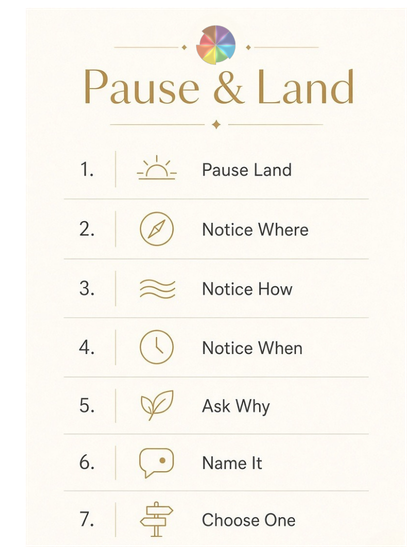
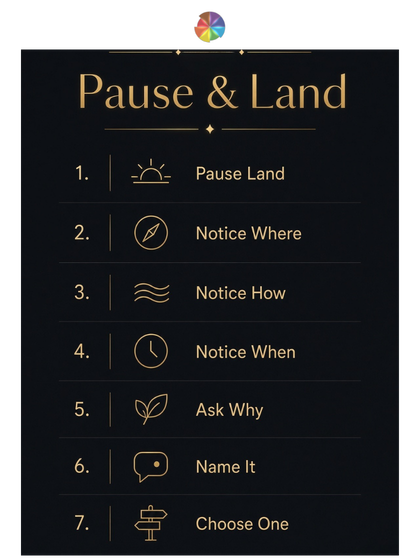
Pause and land. Sit or stand still. Let your shoulders drop. Don't change anything yet.
Notice where. Is your breath moving in your chest, your belly, or both? Put one hand on each if it helps.
Notice how. Is it fast or slow? Smooth or jerky? Are you holding it at the top, or rushing the breath out?
Notice when. Think back over today. When did your breath tighten? Who were you with? What were you doing? What were you about to do?
Ask the question. "What was my body responding to?" Let the first honest answer come. It might be a person, a task, a fear, hunger, exhaustion or a boundary you crossed.
Name it. Write it down in one line. Naming it is the first step to changing it.
Choose one small response. Not a life overhaul. One thing: a conversation, a break you protect, a meal you don't skip, a "no" you finally say.
Do the audit once a day for a week. Patterns appear quickly. Many people discover that what's hindering their health isn't the obvious thing they'd have guessed.
Three breaths for a shift
Once you know what your breath is telling you, these can help you respond. Each takes a minute or less.
The long sigh (before you walk into a room). Breathe in through your nose, take a second small sip of air on top, then breathe out slowly and fully through your mouth. Repeat two or three times. This is the cyclic sighing pattern used in the trial above [2].
The 4–6 breath (when your mind is racing). Breathe in for a count of four, out for a count of six. A longer breath out helps your body slow down. Keep going for a minute.
Belly breathing (on your break). Place one hand on your chest and one on your belly. Breathe so that the lower hand moves more than the upper—five slow breaths.
Good to know: if any technique makes you dizzy or anxious, stop and breathe normally. Avoid forceful, fast breathing practices (hyperventilation-style breathwork) unless you're guided by someone qualified, especially if you have a heart or lung condition or are pregnant.
Make it a habit
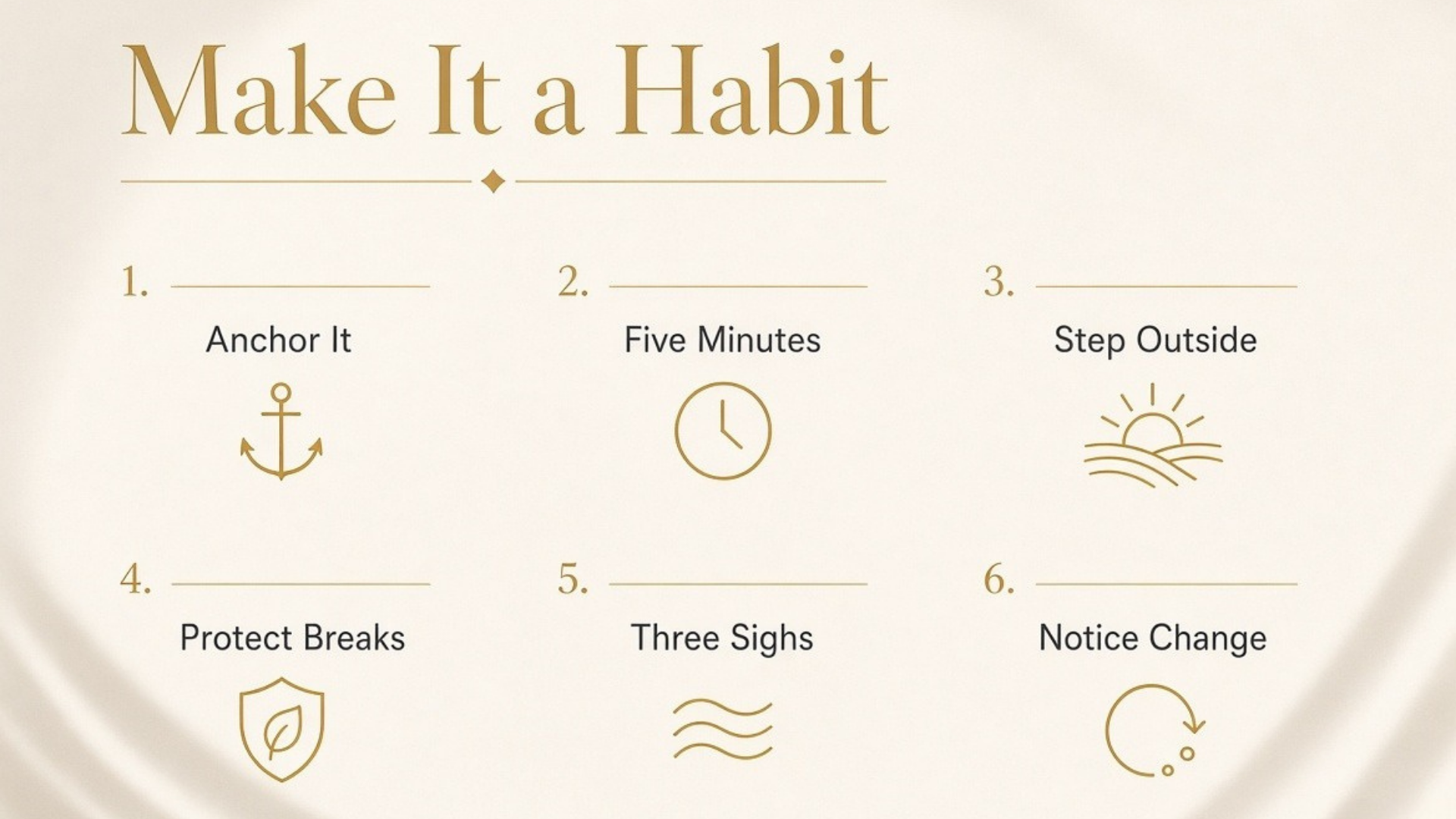
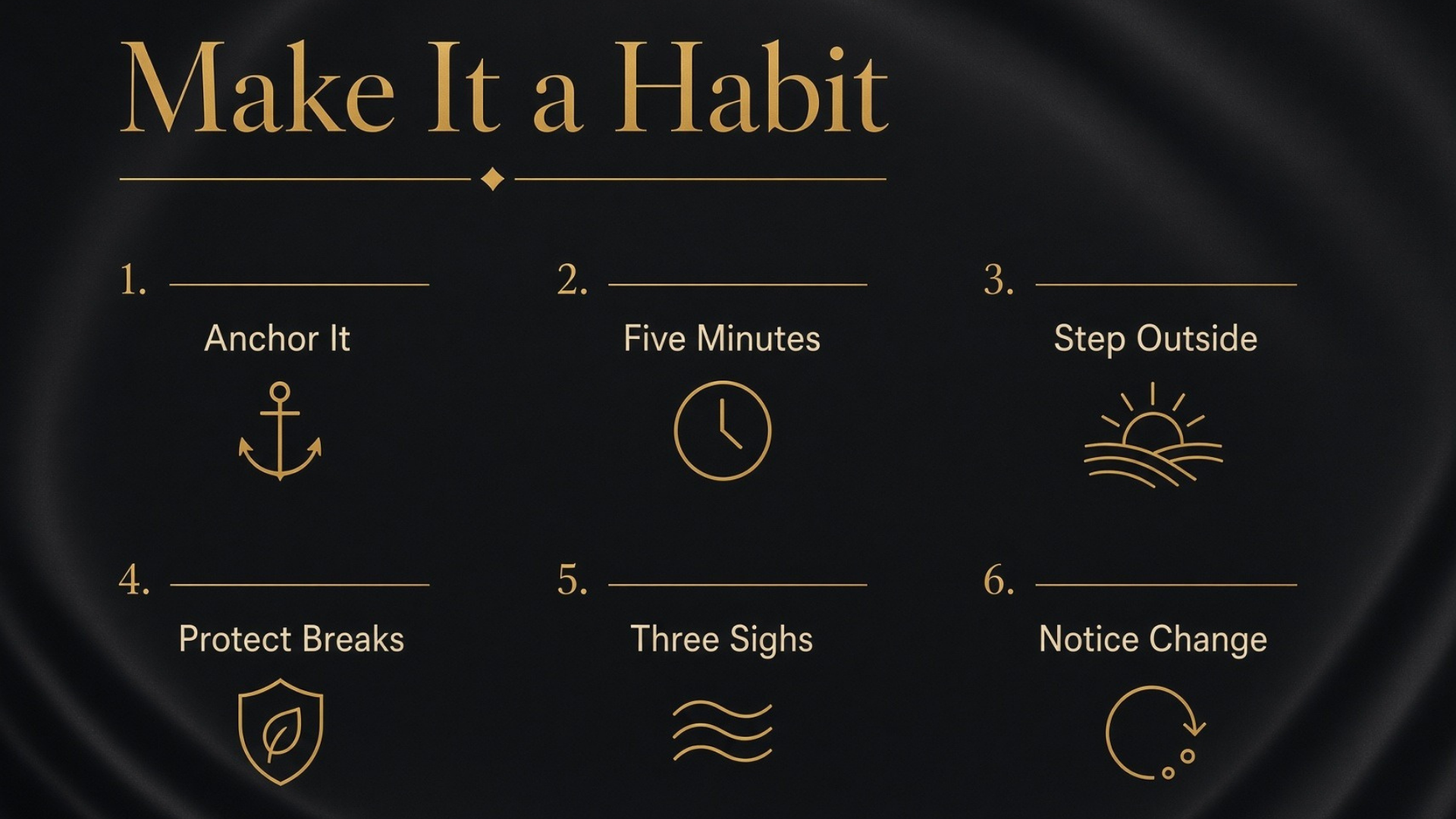
Anchor it to something you already do: hand hygiene, logging in, the lift doors closing.
Five minutes a day is enough to start. That's the dose used in the trial that improved mood [2].
Step outside when you can. Fresh air and a change of scene make the practice easier.
Protect your breaks. A boundary around your break, even ten minutes, is part of the practice, not separate from it.
Try This Now: Before you read on, take three long sighs. Then notice: what changed?
Every breath is a minute of your life.
Each year gives you a little over 524,160 minutes. You'll spend many of them caring for others. The breath audit asks for just three of them, for you. Not to fix everything, but to finally hear what your body has been trying to say.


"Your breath has been talking to you all along. The work is learning to listen."
Patricia Maris
What the studies cannot tell us
Results for healthcare workers specifically. Most breathwork trials were in healthy volunteers or students [1][2].
Long-term effects. The trials ran for weeks, not years.
Which technique suits you best? Effects were modest on average [1]. Try a few and notice which one your body responds to.
When to get help
Breathing practices are a tool, not a cure. If you're feeling exhausted most days, low, numb, or like you can't keep going, please talk to someone: your GP, a psychologist, or a colleague you trust. Doctors and nurses can also access confidential support through DRS4DRS and the Nurse & Midwife Support line (1800 667 877).
If you need to talk to someone now, call Lifeline on 13 11 14, any time. In an emergency, call 000.
See your GP too if you notice breathlessness, chest tightness or dizziness that doesn't settle with rest.
Asking for help is a skill you use for others every day. You deserve it too.
Key Takeaways
Breathwork can lower stress. Across 12 trials, people who practised it reported less stress, though the effect was modest [1].
Five minutes a day can help. Daily cyclic sighing improved mood in a month-long trial [2].
Your breath is a messenger. Notice when it tightens, and with whom, to find what's really costing you.
Try the breath audit. Three minutes a day for a week to reveal your patterns.
Breathing is a tool, not a cure. If you're struggling, reach out for support.
View Recommended Resources
Fincham GW, Strauss C, Montero-Marin J, Cavanagh K. Effect of breathwork on stress and mental health: a meta-analysis of randomised controlled trials. Scientific Reports. 2023;13:432. doi:10.1038/s41598-022-27247-y source
Balban MY, Neri E, Kogon MM, et al. Brief structured respiration practices enhance mood and reduce physiological arousal. Cell Reports Medicine. 2023;4(1):100895. doi:10.1016/j.xcrm.2022.100895 source
Zaccaro A, Piarulli A, Laurino M, et al. How breath control can change your life: a systematic review on psycho-physiological correlates of slow breathing. Frontiers in Human Neuroscience. 2018;12:353. doi:10.3389/fnhum.2018.00353 source
Further reading: James Nestor, Breath: The New Science of a Lost Art (2020).



 Insight




 Movement







 Sexual Vitality
